Poems and Stories

Wednesday, August 14, 2019

The Flannels of August


The Flannels of August


The granddaughter -
She was 15, tall and thin, growing up too fast. It was a clear but cool Maine morning in August. She picked out a black and white checkered flannel shirt from the closet in the soldier room (named for the 50 year old wallpaper). It had belonged to her grandfather and was kept in the closet all winter. It was damp from the basement below the closet but not moldy. She sniffed the arm and tried to remember her grandfather's smell. It had been too long and she couldn't smell him but she tried to believe she could. Everyone else in the old house was still asleep so she quietly slipped out the back door, closing it gently so it wouldn't slam. She was barefoot and the grass was wet and heavy with dew. Some bird on the bay made a strange lonely, singular cry. That's a Loon, she thought. Her grandfather and her father had told her that years ago.
The daughter -
The small, black and white checkered flannel shirt was too thick and too warm for August but she always wore it in the garden because that was where her father wore it when he was alive and still able to work outside. She remembered the years when he seemed possessed by the garden and the yard, working late into the evening until her mother called him in for dinner. Whacking the weeds to keep them back, out of the yard, cutting and hacking everything as if to gain some control and restore order. She saw the signs of dementia early but it took 10 years to take him completely. She fought along side him for all those years but they both lost. Now, she had his flannel shirt and it still smelled like him, she believed.
The son -
As soon as the August sun reddened the sky over Islesboro, he would open his eyes, with some effort as he was still tired and a little rough after last nights late dinner and drinks by the fire pit, roasting marshmallows for the kids and drinking another ice cold beer. The sun warmed his face, the best alarm clock on the Maine coast. He got up and walked to the closet for a shirt. His sister had stocked up on warm flannel shirts at the Goodwill in Rockland and kept them in the closet in the Yellow House for summer family and guests. He picked out a faded brown and purple one, soft as a chamois, and put it on as he walked to the kitchen. After he made coffee, he grabbed his rod and headed for the dock. The tide was wrong but it didn't matter. He might still catch and release a few mackerel before breakfast.


Big Red: the grandfather, father, and devoted husband to Martha -


He was cold again. August in Maine should be warm but to him it was always cold, everywhere. He was wearing his long johns and opened his eyes but only saw the ceiling. White, empty. He reached out his left hand as he did every morning for the past 60 years to find Martha She was there. Asleep and snoring gently even though the rising sun was bright on her face. He got up slowly, put his feet on the cold, hard, wooden floor and shivered. The rug was not there so he walked to the dresser and got out a pair of socks. The closet door was open but there was no light and he did not want to turn one on so he reached in and felt around for a shirt. A warm shirt, like flannel, but a thick one to keep him warm. He found one, slipped it on over bony shoulders, walked slowly to the bathroom, closed the door, pulled down on the string to light the room and looked at the shirt as if he had never seen it before. Black and white checked, thick flannel and warm. He put it on and walked into the living room and sat on the old, red couch, scratching the left arm of the couch as he waited for Martha to get up and fix his breakfast.

Tom Crowley
August 11, 2016 & August 13, 2019
Lincolnville Beach, Maine


Wednesday, May 22, 2019

Marguerite and The Cuban Paintings - Chapter Four - Havana (DRAFT)


National Museum of Fine Arts - (Museo Nacional de Bellas Artes) 1925
Rodriguez Morales stared at his clock. 5:46 am. A Westclox Baby Ben. He had purchased it from a street vendor in Havana several years earlier. It kept good time, losing only a minute every week. The glass face was cracked, and the alarm bell did not work. The steady “tick-tick-tick” was a heartbeat to Morales he needed this morning. It filled the small office with a comforting sound.
At 7:00 am he was meeting Captain Francisco Agramunt, his wife's cousin who claimed to have important art information. This meant he needed money and knew he could tempt Morales with any line containing the words; art, artworks, sculpture, etc.
6:00 am. Time for coffee. Morales turned in his chair and opened the door of a small, oak cabinet behind him. He pulled out three items that made his morning coffee ritual both sacred and perfect; The first was a simple drip coffee pot. However, this one was special. It was a Ferraro 2-cup Napoletano drip espresso pot made in Italy. Morales found it in one of the many “antique/junk” shops around the corner from the museum and had to have it. The second item was an old coffee grinder, rusted, black paint faded and worn. It was a Universal Coffee Mill and labeled “No. 110 One Pound” made in New Britain, Connecticut. Morales’ mother had used it for years to grind black pepper but now it was his and after cleaning, polishing and sharpening the gears it was ready for coffee. The coffee was the most important part of Morales’ morning ritual. He used exclusively Arabica beans, purchased locally by the Souto family, makers of the most popular brand “Cafe Bustelo”. He chose the dark roasted beans and ground them himself to ensure the freshest blend for his little espresso pot. Morales kept the beans wrapped in wax paper and then stored them in an oleomargarine tin with a tight lid. After grinding enough beans for two cups of espresso plus a little more for strength, he set an old, dented aluminum pan on his hot plate to boil the water. While he waited for the water to boil, he dismantled the four parts of his espresso pot, unscrewing the perforated cup from the bottom of the inner chamber, inspecting the bottom of the pot for holes and wiping the interior of every part with his special coffee rag, part of a flour sack that he had washed many times by hand and kept inside the pot. Satisfied that the pot was ready he filled the bottom cup with coffee, right to the top, and leveled it with his finger, saving every last piece of ground coffee. Reassembling the pot he turned and lifted the pan from the hot plate and slowly poured the near boiling water into the pot. As he waited for the espresso to develop its full, rich flavor he began the next step to make his true, signature recipe for Cuban coffee. He opened another tin containing his last remaining supply of Demerara sugar and looked inside at the raw, golden yellow crystals and sifted two heaping tablespoons into a two cup, glass Pyrex measuring cup so that he could add 1 tablespoon of the hot espresso as soon as it was ready. He removed a small, wooden handled wire whisk from his desk drawer, poured one tablespoon of the dark liquid into the Pyrex glass cup and then beat the sugar with the espresso until pale and thick and nearly dissolved. He then stirred in the remaining hot espresso. As we watched the foam rise to the top, he pulled out his favorite over-sized espresso cup and then poured the now complete formula into his cup. Morales sipped his coffee slowly and thought back to the many mornings he had watched his mother, and then, his grandfather make Cuban coffee this way. Remembering the past always helped him get through the stressful present days. He knew that today would be one of those days.
However, the morning was his now and there was no good reason to change the rest of his morning ritual.
Morales left his office and took his usual path through the museum to the Artes de Europa section. There he found his old friend Mattia Preti waiting for him. He pulled a heavy, dark brown, worn library chair out from a nearby alcove and positioned himself directly in front of his favorite Preti painting; “The Visitation”. A small placard below the painting gave more details;
In this painting, Preti represents the meeting of the Virgin Mary with her older cousin Elizabeth. Mary hastened to visit her kinswoman following the Annunciation by the Angel Gabriel. Elizabeth, who was soon to give birth to St. John the Baptist, recognizes that Mary has been chosen as the mother of the Son of God, and greets her with the words “Blessed art thou among women and blessed is the fruit of thy womb.”
His museum, with a short 12 year history, had few significant works. It was his job to build the museum as a major institution for Cuba. Works of art from Europe were routinely trafficked to South America, with short but deliberate stops in Cuba. Their provenance was not always clear or well-documented but most items were in high demand worldwide and Morales could not afford to miss a chance to buy one for the museum. He hoped that this morning would be fruitful. 6:55 am. Time to meet Captain Agramunt who would be late as usual.
Agramunt, a drunk and a thief, usually had valuable information. He knew this could be sold more easily than the art pieces themselves. However, art history and the collections in Europe were an area where Morales excelled as he had mastered the practice of art acquisition years earlier, in Spain. Now it was time to build his own collection in Havana, for Cuba, of course.
They were to meet at the Cafe De Oriente on the Plaza de San Francisco near the Terminal Sierra Maestra. However, Morales wanted to control this meeting to make sure El Capitan knew who held the cards and the money so he countered that they meet in Old Havana on Avenida Amargura where there was a small cafe with excellent coffee and a small room in the back with the privacy they would need. He enjoyed walking through the streets of Old Havana and its magnificent buildings. Starting, of course, with the El Floridita, across the street from the museum at the Obispo street entrance. As he strolled down Avenida Belgica past the narrow street of Obrapia and then Lamparilla, the smells of roasting Arabica coffee beans was too tempting to resist and by the time he reached Old Havana, he had consumed two small cups of Cafe Cubano, the rich, dark coffee flavored with demerara sugar. It was not as good as his own brew but it was necessary for this day.
El Capitan woke up on his ship with an extremely bad hangover, as usual, and had rinsed his dry mouth out with sweet rum before leaving the ship with his aviator sunglasses on, a cigar in his teeth and barking orders at the crew as he stepped into the launch. It was a short trip to shore but he felt every wave like a punch in the gut. He needed coffee, badly. Especially if he was to make a good deal with Morales.
Agramunt shouldered his way past an older couple waiting at the door of the Cafe and squinted into the comparative darkness of the small shop. Morales stood up from his table in the back nd waved. Agramunt did not see him or did not acknowledge the wave. He simply weaved through the morning crowd, flopped down on a chair opposite Morales, put his greasy head down on the small table and held his head in his hands as he waved the waiter over for his coffee.
He said nothing at all until he had consumed two cups of the strong coffee and then, through bloodshot eyes he looked up at Morales and with a sickly, greenish smirk said;
Morales, I have great news for you but it will cost you...a lot”
This was the same opening Agramunt used every time they met. Most of the time it was some small bit of information that Morales already had from his own art “informadors” all over Havana who would cheerfully share each item with him for a cup of coffee. However, this was a cousin and Morales knew the routine.
Wonderful to see you El Capitan! You are looking well. The salt air has done wonders for you. Please share this valuable news with me immediately my friend!”
Morales quickly took a deep gulp from his coffee to swallow the bitter taste of bile in his mouth and to cover his own fake smile of disgust.
Ahhhh Morales, Morales, my cousin and dear friend, this news is so great and valuable that I am not sure you are financially able to induce me to share it with you. However, as it involves priceless works of art and sculpture, just now being off-loaded from the Hercules, I am certain that you will find a way….”
Morales tried but failed to remain calm. He could not believe this story but was unable to contain his curiosity and leaned forward to hear more from Agramunt.
Please go on, Capitan Agramunt”
Of course! Of course! After we have eaten and had our visit! Cameraro! Ven Aqui!”
The Home of Salvatore Buffardi
Salvatore Buffardi sat on his deck overlooking Havana Harbor drinking coffee with his morning cigar. God, he hated these things but felt obliged to love them for the sake of his business, which was selling old masters art works to wealthy Cuban families. In 2 hours he had to meet with Alfredo Zayas, the President of Cuba, and his assistant, to discuss the sale of 43 hand-picked works of art that had just arrived from Cadiz, Spain and were still crated and hidden aboard a freighter in the harbor. He knew they were safe and on board because the flag above the freighter “Hercules” showed a simple design; a white square knot on a purple flag. This was the symbol he instructed the Captain to raise when his ship passed the El Morro Castle. Few, if any people in Cuba would know or care what this simple flag meant. The fact was that this was the symbol for the city of Cadiz, which depicted Hercules holding two lions. The ancient symbol for Hercules was the square knot. The valuable cargo was cleverly hidden aboard the vessel and the Captain and crew had been sworn to secrecy. Secrecy that would not last an hour after any one of the crew landed on shore.
President Alfredo Zayas was a fool and a poor leader for Cuba. He was also a very clever and violent man who hid behind an image of an aristocrat, an “amante del arte” who supported the arts and artistas of Cuba. His stronghold over Cuba would end soon for while some poets make good leaders of a revolution, Zayas was not one. However, his desire to leave a legacy to the Cuban people in the form of a bequest to the museum was an advantage for Buffardi. Buffardi knew that the works on board the Hercules were nothing compared to the collection hidden in his secret basement vault. These he would sell to the wealthy Americans filling the bars and casinos of Havana. Buffardi took one last look at the harbor, his ship, and the sun coming up over El Capitola...Today would be a good day.
End of chapter four – 01/01/2018 -7:23 am
next chapter notes
  1. Buffardi decides to have a party to unveil the new paintings with Zayas in attendance pretending to see them for the first time…
  2. Morales is invited to the party – Buffardi does not know that Morales knows all about the paintings – Morales does not know about Zayas plan...
  3. Zayas plans to make a grand statement to the wealthy and important attendees that he will be buying ALL of the paintings and donate them to the Museum!
  4. Morales gets an invitation to a Buffardi Party to View his new Paintings
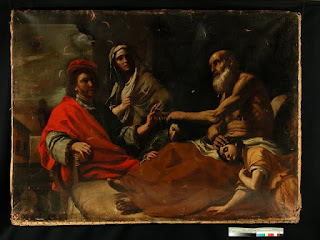
  5. Morales sees a Preti on the wall – it is labeled “The Dying Tobias” but Morales knows it is really a famous painting by Preti known as “Jacob Blessing The Children of Jacob”
  6. After the party, Morales approaches Buffardi and asks about the Preti painting...”Would Buffardi donate the Preti to the Museum?” Buffardi is evasive and dismissive and Morales leaves with little hope
  7. The next day, the paper announces a “gift” of paintings by European masters from President Alfredo Zayas to the Museum. He knows that The Captain was right and that Buffardi always intended to SELL the paintings not donate them.
  8. Regardless, Morales awaits the delivery, expecting the Preti to be among the shipment...its not there
  9. Buffardi decides to keep many of the best paintings but has a gambling debt to Severino Marazzos Y Andrade and has to give his remaining paintings to satisfy the debt (1937)
  10. The Zayas government learns of Buffardi’s betrayal by holding back the best paintings and orders his arrest. Buffardi escapes to the USA and ends up in New York as an “Art Critic”
  11. Severino Marazzos Y Andrade gives the paintings to Nicolas E Meneses, diplomat, who smuggles them to America that same year (1937). He is asked to hold the paintings until he hears from Andrade.


FTC Artist Statement - May, 2019


I am currently applying for a creative writing fellowship from The CINTAS Foundation
This is a DRAFT of the Artist Statement I will submit:
The main body of my work for the past 50 years has been poetry, used to express strong emotional feelings of sadness, loneliness, desperation, morphing into recovery, self-awareness, healing and joy as my life progressed from growing up with alcoholic parents, through deliquency, to a successful career and the gift of a wonderful supportive family. Through poetry, short stories, children’s books and a novel in progress I hope to inspire others to look beyond themselves and their personal life challenges and see the world as a place where they can make a difference and a contribution. Raising the consciousness and conscience of my readers to embrace integrity and love while rejecting hate and racism is a goal that sometimes appears as elusive as a windmill yet no less worthy to pursue.

My work has ranged from and been inspired by the fears and hopes of childhood, through traveling as a search for meaning, imprisonment as a delinquent, the humiliation of social rejection, debilitating injuries, to serving others through charitable organizations and venturing deeply into my family’s past and exposing their secrets as a healing process.

My current project “Marguerite and The Cuban Paintings” is a fictionalized non-fiction story that tracks a small collection of historic and valuable paintings from the 17th and 18th centuries through
Europe, Spain, Cuba, and the United States focusing on the people closest to the collection and how it affects them, changes them, inspires them, and in some cases destroys them. The painting’s are real and I have seen them after they had been hidden in my grandfather’s basement for 50 years and then gradually destroyed over the next 20 years. The family charged with their safe-keeping is my own, on my mothers side; a Cuban diplomat exiled with his family to America. The mute, haunting journey of the paintings tormented the conscience of my Cuban-American family hiding the guilt and shame of smuggling or theft and ultimately killing most of them.
I have chosen a path of discovery, learning, determination and integrity led by a fictitious young women who learns more about herself and her true identity than she does about the paintings. She is determined to find and return them to their rightful owners or their families, thus mirroring a journey that she wishes to experience.
The ultimate goal and purpose of my past and current writing is to leave a documented legacy of my own life’s journey for my family to use as they grow and then question their own identities and the source of their emotions and inspirations. This goal is one that I have had, through my writings, the pleasure of sharing with others; friends, family, and often people who I have never met. Their feedback and reactions are usually positive but always surprise me and validate my decision to write.

Tuesday, October 23, 2018

Marguerite & The Cuban Paintings - Chapter 14 - Havana - 1934


Chapter Fourteen – Outside Havana – February, 1934


The Dying Tobias, by Mattia Preti, known as the Cavaliere Calabrese, 1613-1669
(Neapolitan School)


9 am, Monday morning, February 12, 1934. Salvatore Buffardi sat at his desk in his underwear drinking strong Cuban coffee sweetened with six small spoonfuls of pure cane sugar. Striped garters held up thin black socks over purple, swollen veins that read like a map of the Cuban countryside. His navy blue suit hung on a mahogany valet stand behind his office chair, gold cuff links, his Bulova watch and a diamond stickpin sat in a well-worn tray on top of the stand. This would have been his usual morning ritual if it hadn’t been for the long-awaited yet unavoidable and unfortunate “request” of President Zayas. Today’s event was announced the day before by a short telephone call from Carlos de Vargas, aide to El Presidente:

“Buffardi. it’s time. We will be there tomorrow at 9 am. Have everything ready.”

He was expecting Alfredo de Zayas himself but knew he would not get “El Presidente” to actually come to Buffardi’s home without his full entourage and hand-picked bodyguards and that would mean far too many eyes on Zayas prize. Reluctantly, he got up and dressed carefully as if he were going to an art show instead of his own funeral. Dressed for both he thought to himself.

Buffardi watched as a long, black Cadillac limousine followed by a huge, dirty white truck lumbered up his driveway. The truck’s springs were shot and its body rocked from side to side with every pothole he himself had dug to slow all visitors; family, friends, customers, would-be robbers and assassins, and other enemies, known and unknown. Two men could be seen inside, probably more in the back of the truck. He was expecting them and he was ready. Cuba in 1934 was a time of violence and deception after the Sergeants Revolt led by Fulgencio Batista. Buffardi knew that the Zayas government was under attack from several fronts and could not last much longer. However, to refuse this request would be suicide.

Zayas’ aide and deputy assistant, Carlos de Vargas y Montoya, stepped out of the limousine, looked down at the dust swirling around his perfectly shined cap- toe oxfords and sniffed the air, recoiling at the olfactory assault and digging deep into his vest coat pocket for a silk square.
“Country life! Disgusting. An “artist” in the country. Perfect!”
Dripping sarcasm and a superiority complex were the sad distinctions of this little man, whose political future would never match his egotistical aspirations. Yet, for now, he was a key figure in the Zayas government and the discreet manner in which he carried out Zayas’ instructions were key to his survival, for now.

In 1925, Salvatore Buffardi, known throughout Cuba as a famous art historian and collector had donated 43 pieces of priceless European artwork and sculpture to the Museo Nacional de Bellas Artes de La Habana. President Zayas was furious for being upstaged by this Italian, non-Cuban and insisted that the donation be “re-named” as coming from him. The announcement, covered by all Cuban papers, edited and overseen by Zayas aide Carlos de Vargas appeared as:
President Alfredo Zayas government has made a generous donation
to The Museo Nacional de Bellas Artes de La Habana. Purchased from
the Italian collector Salvatore Buffardi, the collection included 43 works
from the Italian, French, and Dutch Schools and the first one from the
English School, they have now been integrated into the museum.”

To ensure that this donation would be properly announced, earlier that week Alfredo de Zayas and his aide paid a social visit to the collector. They were not happy.
“Greetings Senor Buffardi! Congratulations on your success here in Cuba which has enabled you to make such a generous donation to our museum.”

“Thank you El Presidente. It is indeed an honor to welcome you to my home”

“Yes, yes, it is our pleasure. However, there are a few things we should discuss...”

Buffardi’s blood froze in his already cholesterol clogged veins. He knew that discussion meant demands which could not be ignored and certainly would not b a subject of a casual “discussion”. He invited his guests to join him in the library and quickly dropped his large bulk into an overstuffed leather chair with a sigh.

“Wonderful, how may I be of assistance?”

“I have been thinking about how it would appear in our papers if this donation were to come from my government instead of from a non-Cuban immigrant such as yourself. “

Buffardi was speechless and knew that the next words spoken could be his legacy or his last:

“That is very interesting Presidente. You may be correct.”

This was the wrong thing to say and Buffardi knew it as soon as the words left his trembling lips.

“I am correct and that is why I am leading this country. I have also been thinking about how you, should you wish to consider my offer rather than accept it with gratitude, would look in a painting of you by someone like Francisco Goya when you have no eyes and no hands and are sitting in front of a blank canvas. You would be the perfect subject!”

The silence in the room was deafening. Finally, Buffardi spoke;

“I have an excellent idea, if you agree, of course! Why don’t we announce that the donation came from you and your government! Further, and as a way of apology for my crass presumption, why don’t you select a few items from my own personal collection here!”

“A wise decision and a good idea. Carlos! Hand me the list.

A LIST? Buffardi was again speechless and terrified at the same time. What list could this smug little pathetic ignorant politico have prepared? Carlos de Vargas enjoyed the abject fear in Buffardi’s pale, fat face as he shoved the list into the collector’s shaking hands.

Before he could stop himself, after reviewing the list quickly, Buffardi blurted out:
“You can’t be serious!”

Again, the wrong thing to say to El Presidente.

Vargas spoke next and probably saved Buffardi’s life.

“I will return next week with my men and a truck to collect these few items, pack them up, and deliver them to the President’s private residence. Shall we say Monday at 9 am?”

That Monday meeting did not occur for over ten years. For all that time, Buffardi felt he was under “house arrest” until the delivery of the paintings could be completed and he would be free to leave Cuba for the United States and New York, where his own provenance and reputation would be an asset rather than a liability.


To Love a Church


Saint Thomas Episcopal Church
Camden, Maine

There was an old church
in a very old town
near the water
that ran down to the bay.

The people attended
for a very long time
but then
they drifted away.

The church was alone
and starting to fail
as the mortar and glass
crumbled away.

But then a young girl
who chanced to attend
with her grandmother
on one special day

Fell in love
with the church
and decided to save
her pennies to find a way


To restore the old church
and bring people back
To worship and
hopefully stay.

Soon many came back
and new people too
The church was
happy and gay.

They all saved their pennies
and fixed up the church
and that is how
you see her today.

Now the Sunday school
is filled with laughter
of children who
loved the church in a new way

The little girl grew
and then took her vows
now she is
the Rector today.


Monday, October 22, 2018

Please Come Back


Please come back
and throw your
clothes on the floor
Come back now
and forget the door

leave it open
so you can return
to ease the pain
and stop the burn

Of an empty room
and an empty heart
once filled with love
before your depart

Please come back
let the dishes sit
wherever you put them
I don’t give a ____.

I miss the things
you left behind
like a spatial spore
to mark the place
you were before.

Come back, come back
it will be all right
we will never shout
and never fight.

We’ll just hold each other
under a blanket or coat
and watch TV
you can have the remote.

I know you’re out there
My world is off track
I can feel you are close
please...come back.

Tom Crowley – 10/22/18


Thursday, September 13, 2018

Marguerite and The Cuban Paintings - Chapter 1


Wayne PA – 1985


Anne picked up the large claw hammer Jim had left on his work bench and an old flat head screwdriver and walked out into the backyard. The sun was just coming up and could be seen between the leaves still on the branches of the huge oak trees surrounding the house and grounds. The smallest of three old dusty, wooden crates lay on the patio where she had dragged it from Jim's hiding spot deep in the far corner of the basement. The other two crates were far too large for her to move; the largest measured 5 feet by 10 feet and the next smallest was 3 feet by 5 feet. Even the smallest one was very heavy as evidenced by the scratch marks on the basement floor and the twinge in her lower back. She been thinking about this for many months but was waiting for Jim to take another extended business trip so she could work alone, uninterrupted and unchallenged. She was alone and that was how she liked it. Just her and Petey, her fox terrier, who was at that moment sharing this experience with her and demonstrating his understanding of and solidarity with her views of the crates by urinating on the one she had out.


Havana, Cuba, 1925

The ancient, rusty freighter slid past the 295 year old El Morro Castle two hours after sunset on September 19, 1925 and entered Havana Harbor where it dropped anchor and, as required by international law and custom, raised the yellow quarantine flag. This flag was sufficient to alert the Customs officials that he was ready to be boarded. This flag was originally intended….. Another smaller square flag, no bigger than an ensign, was hoisted on a second flag halyard. This one had the simple image of a square knot. Meaningless to most sailors today, this was the signal agreed upon code between the Captain and the agents he was supposed to signal on shore. It was the symbol for Hercules who was represented on the flag of Cadiz, Spain.
The Captain raised his binoculars and searched the empty ramparts of the castle for any response to his signal flag. Nothing. He went below to his cabin, opened a greasy porthole and lit the Cuban cigar he had been saving since leaving Cadiz, Spain. He smiled as he reflected on the provenance of the dark, aromatic, tightly rolled cigar in his hand. It was a Quintero Y Hermano, purchased in Cadiz but made here in Cuba outside of Havana in the Vuelto Arriba region on the southern coast. The fragrant smoke soothed him as it circled his cabin and slipped, ghostlike out the open porthole, returning home.
The next morning he awoke at 6 am to go on deck and enjoy a blindingly brilliant sunrise which cast a golden pink aura on the white walls of the Castle as he waited for the customs official to come aboard to clear customs. The official arrived with his assistant, leisurely, on “island time” around 9 am. He suppressed his irritation and greeted them warmly in Spanish. After the usual pleasantries they glanced at the manifest listing the cargo, shrugged, smiled and accepted a significant “harbor clearance fee” and left the ship. No more than 15 minutes had elapsed to inspect the 125 foot freighter (research freighters of 1925) and its cargo. With this hurdle out of the way, Captain Vincente was now able to move his vessel to the dock. (add more description here) That evening, the agent he had signaled came aboard with four men to claim three large wooden crates. The crates contained over 100 priceless works of art and sculptures by masters from France, Italy, Germany and the Netherlands dating back to the 16th century.  However, seven would not seen again until May, 1935 when they were produced to satisfy a debt owed by Salvatore Buffardi, Italian art critic, to a Severino Marrozos y Andrade. In 1937, they were smuggled out of Cuba on a diplomatic flight to Miami, Florida.  From 1937 until 1985 they AGAIN remained hidden in the basement garage of a small townhouse in the suburbs of Philadelphia. The house was owned by my maternal grandfather, Nicolas E. Meneses, Consul General for Cuba under General Fulgencio Batista.


Wayne, Pennsylvania, 1985


She thought she knew what was in the three, strange secret crates but she had never seen their contents because Jim forbade her and young Jimmy from ever touching them. They had been delivered to her house by an unmarked white van, unloaded by two large strange dark men who did not speak English but only smiled and nodded to her endless questions. They dragged the three huge, dirty, dusty old wooden crates into the basement, scratching the floor as they could barely lift the largest one, and then, the nerve, wrapping a huge chain around all three boxes, locking a padlock to the chains and then, pocketing the key. She demanded that they give her the key but they only nodded, smiled, and walked back to the van and drove away. Morons!
Anne, still in pajamas and an old, cotton robe with coffee stains, sitting on a couch in the living room, ashtray full and overflowing, with a cigarette and a cup of black coffee in her hand, hesitated before she called Jim at his office. She knew she would have to get through Isabel, Jim's “secretary” to reach Jim. She hated Isabel and Jim knew it. Why he kept her on was beyond Anne's belief but not her understanding. Straightening up as best she could, she dialed the number she had called so many times before, wincing as Isabel answered, deliberately, on the third ring:
Attorney Meneses' Office. May I help you?”
Yes. Get Jim on the phone. Now.”
May I ask who's calling”
What a bitch! She knew my voice but always played this game!
You know who it is Isabel. It's Anne. Now get Jim on the phone!” Her voice was shrill and insistent but she thought she sounded weak and desperate and hated the girl even more for this feeling.
Of course, Mrs. Meneses. How are you?”
Fine. Where's Jim?”
Oh, he is in his office but has a client with him. Shall I tell him you called?”
No! Tell him I am on the goddamn phone and need to talk to him immediately!”
You know I would love to do that for you but Mr. Meneses insisted that he not be disturbed”
She faltered, wondering who was in his office that was so important that he could not take HER call. Then she spoke
You go in there and tell him I am on the phone! Now!”
You know I would love to do that for you but you know Mr. Meneses. May I tell him what this is in reference to?”
No! Just, just tell him I called and that he needs to call me back as soon as possible. It's urgent that I speak with him directly!”. She hung up, slamming the phone down hard so it would be clear to Isabel how important and mad she was. Bitch. Whore. I know she is fucking my husband.
Jim did not call her. He walked into the house at 7 o'clock, his usual arrival time after a long day at the office. Sure. She knew where he was and what he was doing with that whore, Isabel.
Honey, I'm home!”
Jim! Why didn't you call me back! I needed to speak to you about those men and those horrible, dirty crates and why are they locked up, and why wouldn't they give me the key! “
Hi Jim! How are you? Did you have a good day?” He mocked her with his usual smart-ass comment that he made almost every day.
I'm serious! What is going on?”
Lets have a cocktail and I will tell you all about it...”
That was ten years ago and he had never unlocked the chains or given her the key. However, she had found the key a few weeks ago in the basement. She had been cleaning the basement and mopping the floor when she bumped into an old oak secretary containing family photos and some of Jim's old textbooks from law school. The key was wrapped in waxed paper and had been taped to the back of the secretary. It dropped to the floor when she moved it to clean behind it. The key!
She ran over to the corner of the basement where the crates had been stored and locked up with chains and the old padlock. She tried the key. It worked and the chains fell to the ground, noisily. She froze where she was and listened for Jim or Jimmy upstairs. Nothing. Fearing discovery by her husband, yet not knowing why she should fear him, she quietly replaced the chains, locked them, and put the key back in its hiding place. Another time. Yes, another time when she could unlock the secrets of those strange wooden crated with Spanish words all over the outside and crumbling customs stickers and faded stamps that she could a barely read:

ENTREGAR A -
NICOLAS E MENESES
1123 ARDLEIGH STREET
YEADON PENNSYLVANIA USA
DE -
SEVERINO MARROZOS Y ANDRADE
HAVANA CUBA


She waited one more agonizing week. After Jim had gone to his office, she walked into the basement, unlocked the storage area and dragged the largest crate out into back yard and stood there staring at the crate for a few minutes. Then she picked up the hammer and screwdriver and went to work. The more she struggled with the tools and the stubborn, rusted nails securing the crate's lids, the angrier she became. A small drizzle of saliva dripped unnoticed down the right side of her open mouth until the first lid came away in broken pieces revealing a huge oil painting set in a gold-leafed wooden frame...
to be continued ….FTC – 7/19/18

NOTES FOR REST OF CHAPTER ONE -


  1. Cite sale of artwork to National Museum of Fine Arts by S. Buffardi – 1925
  2. Refer to or copy letter from Cuban Clerk – 1935
  3. Describe Meneses last, diplomatic flight from Cuba in 1937 with family, possessions, and paintings aboard
  4. VARIATION! -
    1. Nicholas Meneses goes to Cornell, becomes agent for family sugar business
    2. Use picture of Meneses in 1948 at port in Philadelphia, PA, USA with sugar from Cuba! (assume paintings smuggled inside shipment and then taken to Yeadon, PA)
My grandfather is the short one on the left holding, what else...a cigar